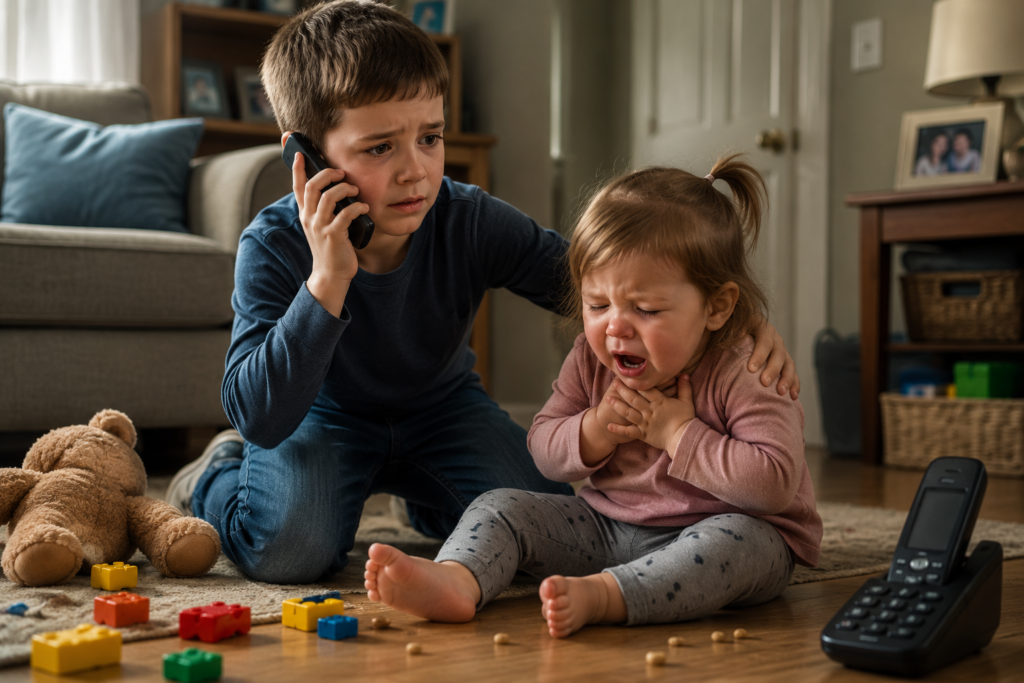
You asked nicely three times. Your toddler looked right at you, smiled, and poured the juice on the floor anyway. Your voice went up before you even decided to raise it — and then came the guilt. If you are searching for how to stop yelling at your toddler, you are not a bad parent. You are an overwhelmed parent who needs a better system, not more shame.
Yelling is rarely about one spilled cup. It is usually about exhaustion, rushing, feeling ignored, and having no pause between a trigger and a reaction. The good news is that pause can be trained. You do not need to become a perfectly calm parent who never raises their voice. You need a plan that works on real mornings, with real toddlers, when you are tired and running late.
This guide gives you that plan: a full 7-Day Reset, a copy-paste trigger tracker, exact repair words after you yell, and a way to get your partner on the same team. Pair it with our guide on how to get your toddler to listen without yelling.
The short answer: To stop yelling at your toddler, pause before you react, lower your voice instead of raising it, name your trigger, and repair quickly when you slip. A focused seven-day reset — one small practice each day — retrains your response, calms mornings and bedtime, and rebuilds trust without shame or perfection.
How to Stop Yelling at Your Toddler Starts With Understanding Your Triggers
Most parents do not yell all day. They yell at predictable moments: the morning rush, mealtime messes, bedtime stalling, the second request after a long workday, or when a toddler does something unsafe. Those moments share a pattern — a trigger, a body signal, and then an explosion.
Your trigger might be whining, defiance, a mess you just cleaned up, or feeling disrespected. Your body signal might be a tight jaw, hot face, clenched fists, or a racing heart. When you learn to spot the signal, you gain a few crucial seconds. Those seconds are where change happens.
Remember your toddler’s side, too: toddlers have immature impulse control, short memories, and big feelings in small bodies. They are usually not giving you a hard time — they are having a hard time. The American Academy of Pediatrics notes through HealthyChildren.org that children learn more from calm, consistent guidance than from fear. When you yell, they mostly hear the volume — and learn to tune it out or yell back.
What Yelling Actually Teaches Your Toddler (and Why It Stops Working)
A flooded toddler cannot learn the lesson inside your words. When a two-year-old hears a raised voice, their brain shifts into fight, flight, or freeze — the same alarm state adults feel under threat. In that state, reasoning shuts down. They register the volume, not the point. The sentence you shouted is gone; the feeling of being shouted at is what stays.
That is also why yelling eats its own effectiveness. The first time it startles your toddler into stopping, it feels like it worked. By the fifth time, the same voice is background noise, so you get louder to get the same reaction. A few weeks later you are shouting over a child who has learned to tune shouting out — and the volume keeps creeping up while the cooperation keeps going down.
Here is what the pattern quietly teaches, day after day:
- Big feelings get met with bigger feelings. Your toddler learns that when someone is upset, the answer is to get louder, not calmer. Then they bring that same volume to their own frustrations.
- The raised voice is the real signal. If calm requests are followed by nothing and the shout is followed by action, your child learns to wait for the shout. They are not ignoring you on purpose — they are reading the pattern you taught them.
- Conflict means escalation. A child who is yelled at often starts to brace, freeze, or shout back the moment tension rises. None of that is learning the rule. It is learning to survive the moment.
None of this means one bad evening has damaged your child. It means the tool itself is the problem, not your effort. Repair after you yell still matters enormously — it is where your child learns that relationships bend without breaking. But repair covers a slip, not a daily pattern. A good apology does not cancel out yelling every day, which is exactly why the reset below works on the pattern itself, not just the guilt after it.
How to Stop Yelling at Your Toddler in the Moment: The 90-Second Pause
Before the 7-Day Reset begins, you need one emergency tool for the moment your voice starts to rise. Use the 90-Second Pause:
- Stop and plant your feet. Put both feet flat on the floor. If your child is safe, take one step back.
- Breathe out slowly. A long exhale tells your nervous system the danger is passing. Try four counts in, six counts out.
- Get low and quiet. Crouch to your toddler’s level, soften your face, and whisper or speak very quietly. Children lean in to a whisper; they defend against a shout.
- Name the limit in one short sentence. “Juice stays on the table.” “I won’t let you hit.” Short beats long when everyone is flooded.
- Follow through calmly. Move the cup, block the hit gently, or move to a calmer spot.
If you feel you might lose control, take a brief parent time-out. Put your toddler somewhere safe — a crib, playpen, or childproofed room — and step to the doorway for a minute. A short, safe pause is always better than words you will regret.
The 7-Day Reset Plan: One Small Practice a Day
Do not try to fix everything at once. Each day below has one focus, one concrete practice, and one evening reflection prompt. The days build on each other, so go in order, and repeat any day you need. Progress, not perfection, is the goal.
Day 1: Notice Without Judging
Focus: Awareness. You cannot change a pattern you cannot see.
Practice: Today, simply count. Every time you raise your voice, make a quiet tally on your phone or a sticky note. Note the time and what just happened. Most parents discover their yelling clusters around two or three situations — and that discovery alone is powerful.
Evening reflection: “When did I yell today, and what was happening right before it? What do the moments have in common?”
Day 2: Build Your Pause
Focus: Creating space between trigger and reaction.
Practice: Choose your pause phrase — one sentence you say to yourself before you speak to your child. Examples: “He’s two, not twenty.” “Calm is my job first.” “Quiet voice, strong limit.” Use it every time you feel your body signal today, even if you still raise your voice afterward. You are building the habit of pausing first.
Evening reflection: “Did my pause phrase help even once today? Which moment was hardest to pause in, and why?”
Day 3: Fix the Hot Spots
Focus: Prevention. The easiest yell to stop is the one the environment prevents.
Practice: Pick your top hot spot from Day 1 and change one thing about it. Morning chaos? Lay out clothes and pack the bag tonight. Mealtime messes? Use a smaller cup with a lid. Bedtime battles? Start the routine fifteen minutes earlier. Write your one change down and tell your partner what it is.
Evening reflection: “Did my hot-spot fix make today easier? What is one more small change I could make tomorrow?”
Day 4: Replace Yelling With Connection
Focus: Toddlers cooperate more with parents they feel connected to.
Practice: Add ten minutes of child-led play today — no phone, no teaching, no correcting unless something is unsafe. Let your toddler choose the game and lead it. Narrate what they do: “You’re stacking the red block on top!” This small deposit in the connection bank makes limits land more easily the rest of the day. Many ideas in our guide to positive parenting tips for busy families fit naturally into this day.
Evening reflection: “How did my toddler respond to our play time? Did cooperation feel easier afterward?”
Day 5: Use the Quiet Voice and Short Limits
Focus: A new default voice for corrections.
Practice: All day, practice the formula: get close, get low, say the limit in five words or fewer, then act. “Feet stay on the floor.” “Sand stays in the box.” If your toddler protests, acknowledge the feeling without debating the limit: “You’re mad. The answer is still no, and I’m right here.” Try whispering at least twice today — it is your secret weapon.
Evening reflection: “When I used a quiet voice and a short limit, what happened? Did anything surprise me?”
Day 6: Repair Every Slip, Fast
Focus: Repair. Slips will happen this week. What matters is what you do next.
Practice: Every time you yell today, use the repair script below within a few minutes — not hours later. Get low, name what you did, apologize simply, restate the limit calmly, and reconnect with a hug or a shared moment. Most young children forgive remarkably quickly when a parent repairs sincerely.
Evening reflection: “How did it feel to repair instead of just feeling guilty? How did my child respond?”
Day 7: Review, Celebrate, and Set Your Next Goal
Focus: Locking in the change.
Practice: Look back at your tallies and notes from the week. Compare Day 1 and Day 7. Choose the two practices that helped most — for many parents it is the pause phrase and one hot-spot fix — and commit to keeping just those two for the next two weeks. Tell your partner or a friend what you are keeping, so the change has a witness.
Evening reflection: “What is different about our home after seven days? What do I want the next two weeks to look like?”
Your Trigger Tracker Template
Copy this table into a notebook or notes app. Fill in one row each time you yell — or almost yell — for two weeks. Patterns you can see are patterns you can change.
| Date & Time | Trigger | Body Signal | What I Said/Did | What I Wish I’d Done | Fix Idea |
|---|---|---|---|---|---|
| Mon, 8:05 AM | Refused shoes, we were late | Tight jaw | Yelled “Hurry up!” | Whispered, helped with shoes | Shoes by door nightly |
| Tue, 6:40 PM | Juice spilled after I mopped | Shoulders up | Raised voice | Paused, breathed | Lidded cup at dinner |
After a week, circle your most common trigger and body signal. That signal is now your early-warning system: jaw tightens, pause starts.
The Repair Script: Exact Words to Use After You Yell
Repair is not permissiveness. You can apologize for your volume and still hold the limit. In fact, repair teaches your toddler two powerful lessons: everyone makes mistakes, and everyone can make them right.
For ages 12–18 months: Keep it short and warm: “I’m sorry I yelled. That was loud. You’re safe. Mama loves you.” Then reconnect — a hug or a song. Babies this age respond to tone and body far more than words.
For age 2: “I’m sorry I yelled. My voice got too loud. I love you. Shoes still need to go on. Let’s do it together.” Offer a hug, but do not force one.
For age 3: “I yelled, and that wasn’t okay. I was frustrated about the spilled juice, but yelling wasn’t the right way to tell you. Next time I’ll use my calm voice. The rule is still: juice stays on the table. Can we clean it up together?”
For age 4: “I owe you an apology. I lost my temper and yelled, and I’m working on that. Running into the street is dangerous, so you need to hold my hand in the parking lot. That rule won’t change — but I can tell you in a calm voice. Deal?”
The pattern every time: name it, own it, keep the limit, reconnect. Never blame (“You made me yell”) or demand an apology from your child in the same moment.
Calm Words for the Three Hardest Moments
Most yelling does not happen at random. It happens at the same three or four moments, on repeat. Rehearse these lines once, when everyone is calm, so they are ready when you need them. Say them close, low, and once — then follow through.
The car seat standoff. Your toddler arches their back and refuses to climb in. Get close, offer the choice, and give them a job: ‘First buckle, then music. Do you want to climb in, or should I lift you?’ If they still refuse, lift them calmly and buckle them in while you narrate: ‘You are safe. I am helping you in.’ Do not negotiate from three feet away while the clock runs — proximity is the whole trick here.
Leaving the park. This is the moment that breaks most parents, because the transition is the trigger. Warn before you arrive at the hard part: ‘Two more slides, then we race to the gate.’ When the slides are done, count it down out loud — ‘One more slide… now we go!’ — and move. If your toddler melts down, carry them to a shady spot, wait for the crying to soften, and try the walk again. A meltdown at the gate is not a failure of the plan. It is the plan working slowly.
Bedtime stalling. One more book, one more drink, one more trip to the bathroom. Keep your voice boring and your words the same every night: ‘One more story, then sleep. I will sit here for two minutes.’ Then sit, quietly, for two minutes. The sameness is the point — a toddler who can predict what happens next has far less to fight about. If you change the script every night, you are renegotiating the whole bedtime from scratch.
The pattern in all three: warn early, say it once, give a small choice or a job, and follow through calmly. Your toddler does not need a perfect parent in these moments. They need a predictable one.
Get Your Partner and Support People on the Same Team
This reset works twice as fast when the other adults in your child’s life are part of it — and it can feel painfully slow when they are not.
- Share the plan, not a lecture. Say: “I’m working on yelling less. My pause phrase is ‘calm is my job first.’ If I start to go loud, just say ‘pause’ — that’s our code word, not a criticism.”
- Agree on the same short limits. Toddlers relax when rules sound the same from everyone.
- Tag out before you blow up. Either parent can say “I need a tag” and hand over for five minutes, no questions asked. Stepping away is a strength, not a failure.
- Brief grandparents and babysitters on the limits and calm phrases you use, so your toddler hears one consistent message.
- Check in weekly. Ten minutes on Sunday: What got easier? Where do we still lose it? What’s next week’s focus?
When Yelling Is a Sign You Need More Support
Sometimes yelling is not a skills problem — it is a capacity problem. If you are sleeping three broken hours a night, parenting solo without breaks, or dealing with depression, anxiety, or money stress, your fuse will be short no matter how good your intentions are. That is human, not shameful.
Reach out if you yell many times a day despite real effort, feel rage that scares you, worry you might hurt your child, or your low mood is not lifting. Talk to your pediatrician, doctor, therapist, or a trusted friend. Psychology Today’s parenting resources can help you find support. For public-meltdown moments, see our guide on how to handle toddler tantrums in public.
Frequently Asked Questions
Is yelling at my toddler really that harmful if I apologize?
Occasional raised voices, followed by genuine repair, are part of real family life. What worries researchers is frequent, harsh yelling as the main form of discipline, especially with insults or threats. Your pattern matters far more than one bad moment — and changing the pattern is exactly the right response.
How long does it take to stop yelling at my toddler?
Most parents notice a real difference within one to two weeks of daily practice, especially once they fix one or two hot spots. Expect slips for longer, particularly when you are tired or rushed. The goal is not zero yelling forever — it is fewer explosions and faster repair each time.
What should I do instead of yelling when my toddler does something dangerous?
Move first, talk second. Physically stop the danger — grab the hand before the street, lift your child from the hot stove — using a loud, firm “Stop!” if needed. A sharp safety shout is not the same as yelling in anger. Once everyone is safe, get low and state the rule simply.
My toddler laughs when I yell. What does that mean?
Laughter is often a nervous response, not defiance. Toddlers laugh when overwhelmed, when testing whether you are still safe, or when big reactions interest them. Lower your voice, shorten your words, and follow through calmly — the laughter typically fades as the drama does.
What if my partner yells and won’t change?
Start with what you control: your own reset still helps your child enormously. Then invite, don’t accuse — share this plan and the code-word idea. If your partner refuses to engage and the yelling is harsh or constant, a family therapist or pediatrician can be a neutral next step.
Why does my toddler only listen when I yell?
Because the raised voice has become the real signal. If calm requests are followed by nothing and the shout is followed by action, your child learns to wait for the shout. Break the pattern the other way: one calm request, said close and low while you wait for their eyes, followed through the same way every time. After a week or two of that, the calm voice becomes the signal — and the yell stops being the only thing that works.
Is it normal to yell at my toddler sometimes?
Yes — most parents do at some point, and one raised voice followed by a real repair is not what the research warns about. What worries researchers is frequent, harsh yelling as the main form of discipline. Normal is not the goal, though. Repair is, and shrinking the pattern is what changes things. If you are yelling most days and cannot pull out of it despite real effort, that is worth a conversation with your pediatrician — not a verdict on you as a parent, just help for a pattern that has outgrown your own toolkit.
A Calmer Home Is Built One Pause at a Time
You will yell again. Every parent does. But after this reset, you will yell less often, catch yourself sooner, and repair faster — and your toddler will feel that difference.
Start tomorrow with Day 1: just notice, without judging. Then build your pause, fix one hot spot, connect, go quiet, repair, and review. Seven days from now, you will not be a perfect parent — you will be a calmer one, and that is what your toddler actually needs.
Keep reading
The toddler morning routine chart that ends chaotic mornings