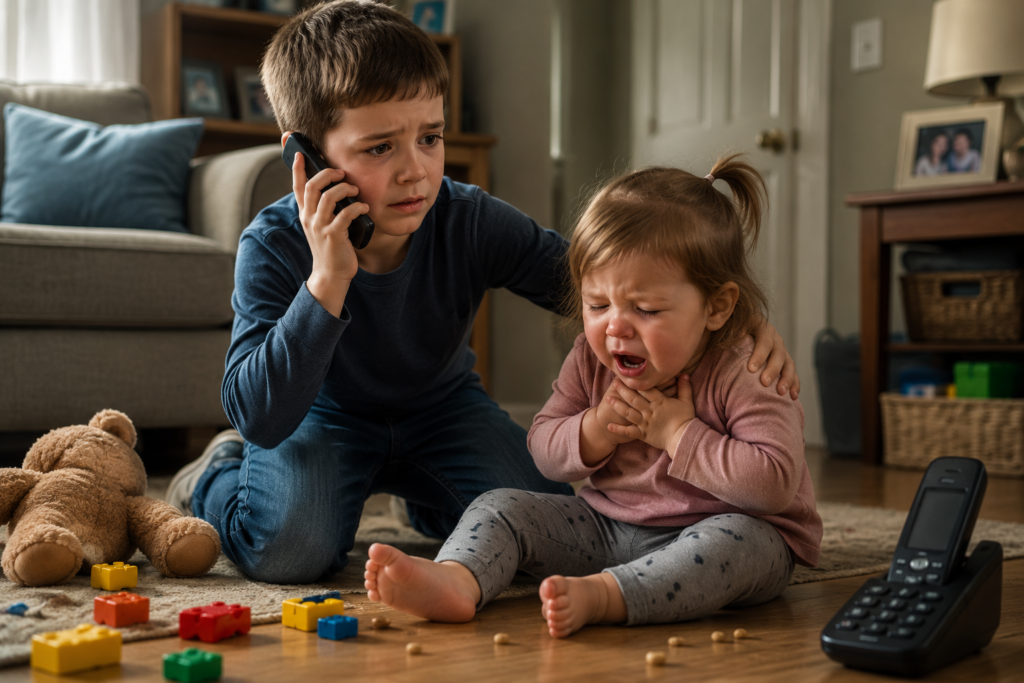
Your toddler is on the floor of the grocery store, screaming because the banana broke. A cart rolls past slowly. Someone is definitely looking. Your face gets hot, and every instinct tells you to fix it fast — bribe, threaten, pick them up and run, anything to make the noise stop.
If you are learning how to handle toddler tantrums in public, you are not failing as a parent. You are parenting a 1- to 4-year-old whose brain is still building the skills for handling big feelings, waiting, and hearing “no.” Public tantrums feel worse than home tantrums because of the audience, not because you did something wrong.
This playbook gives you what to do in the moment, exact phrases for the grocery store, a restaurant, and the playground, a prevention checklist, scripts for strangers’ comments, and the red flags that mean it is time to talk with your pediatrician.
To handle a toddler tantrum in public, stay calm, get down to your child’s level, name the feeling in a quiet voice, keep them safe, and wait nearby without giving in to the demand. If the meltdown escalates, calmly leave the area together until your child settles.
Why Toddler Tantrums Happen in Public
Tantrums are not manipulation in toddlers. They are overwhelm. Language, impulse control, and the ability to shift activities are all still developing. Add hunger, tiredness, bright lights, noise, crowds, and temptations, and public places become a perfect storm.
Target, a grocery store, an airport line, and a crowded restaurant all ask a lot: sit still, do not touch, wait quietly, and accept disappointment — often when a snack or nap is due. Church, playground goodbyes, and parties add excitement and transitions with no warning.
Understanding this changes your job in the moment. Your job is not to win, teach a big lesson mid-meltdown, or impress other shoppers. It is to keep your child safe, stay calm, and ride out the wave without giving in to the demand. Teaching happens later, when everyone is calm. For strategies that build cooperation at home too, see our guide to positive parenting tips for busy families.
How to Handle Toddler Tantrums in Public: The 5-Step Calm Playbook
Use the same five steps every time, in every venue. Consistency helps your child learn what to expect, and it helps you too — you do not have to invent a response while stressed and embarrassed.
Step 1: Pause and Regulate Yourself First
Take one slow breath. Unclench your jaw. Drop your shoulders. Remind yourself: “This is loud, not dangerous. People will forget this in five minutes.” Your child borrows your calm. If you whisper and slow your movements, you give them something steady to settle against. If you raise your voice over theirs, the tantrum gets louder and lasts longer.
Step 2: Get Down, Get Close, and Keep Them Safe
Crouch so you are at eye level. Move breakable items out of reach. If your child is in a walkway, parking lot, or other unsafe spot, calmly move them to a safer place — a quiet corner, the car, a bench outside the restaurant, or a calmer area of the playground. Say very little: “I’m moving you to a safe spot. I will stay with you.” You are reducing stimulation, not punishing them.
Step 3: Name the Feeling in a Few Quiet Words
Toddlers melt down partly because they cannot yet say what they feel. Naming it helps, even if they keep crying: “You wanted the cookie. You’re mad. It’s hard to hear no. I’m right here.” Keep it to one or two sentences. A long lecture will not land during a meltdown — their brain is not ready for reasoning yet. Save teaching for after the storm.
Step 4: Hold the Boundary Without Giving In
This is the hardest step when people are watching. Giving the cookie, toy, or extra ten minutes ends today’s tantrum — and teaches that screaming in public works, making the next one more likely. Hold the limit kindly: “I know you want it. The answer is no. You can be mad. I love you.” Say it once or twice, then wait. Quiet consistency is more powerful than volume.
Step 5: Wait It Out, Then Reconnect and Move On
Stay nearby. Some toddlers want a hug right away; others need space until crying slows. Do not walk away or threaten to leave them — that creates fear, not learning. When crying eases, reconnect first: water, a hug, or a hand to hold. Then restate what is next: “All done crying. Now we finish shopping. You can hold the list.” Praise the recovery: “You calmed your body. Thank you.” Later at home, a brief recap is enough: “The store was hard today. Next time, we will bring a snack.”
Exact Phrases to Say in Public, By Venue
Different places need slightly different words, but the tone stays the same: quiet, short, and kind. Whispering often works better than full volume, because your child has to quiet down a little to hear you.
At the grocery store or Target:
- “You want the cereal. We are not buying it today. You can put the bananas in the cart.”
- “This store is loud and bright. Let’s take a break by the water fountain, then finish.”
- “You can walk holding the cart, or ride in the cart. You choose.”
If the tantrum escalates mid-aisle, park the cart with an employee, take your child to the car for a reset, and return when calm. Abandoning a cart once is better than escalating distress for both of you.
At a restaurant:
- “Waiting for food is hard. Let’s color while we wait.”
- “You want to run around. In a restaurant, we sit or we take a walk outside together.”
- “You’re done sitting. We will step outside for fresh air, then come back to eat.”
Order your child’s food early, ask for the check when entrees arrive if you sense the limit approaching, and take walks outside between courses. Taking a meal to go is a practical choice, not a defeat.
At the playground, church, or a party:
- “You don’t want to leave the slide. Leaving is hard. We are leaving in two minutes, then we will have a snack in the car.”
- “Church is quiet time. We can whisper, look at the book, or step into the lobby together.”
- “You wanted another turn. Your friend is having a turn now. I will help you wait.”
Give a two-minute warning before every transition — “two more slides, then shoes.” Toddlers handle endings better when endings do not ambush them. For more on building listening skills, read our companion guide on how to get your toddler to listen without yelling.
What NOT to Do During a Public Tantrum
What you avoid matters as much as what you do. These common reactions tend to make tantrums longer, louder, or more frequent.
- Do not yell, threaten, or shame. “Stop embarrassing me” and “Big kids don’t cry” add shame to overwhelm.
- Do not give in to end the scene. Handing over the forbidden item teaches that public screaming works.
- Do not make threats you will not keep. “We are never coming back to this park” loses power when you return next week.
- Do not spank or use physical punishment in anger. It escalates distress and does not teach the missing skill.
- Do not ignore a child who is unsafe. Waiting out a tantrum never means walking away while your child runs toward a parking lot or hurts another child.
- Do not apologize to the whole store. A brief “We’re working on it” is enough. You do not owe shoppers a parenting defense.
- Do not record, mock, or laugh at your child. It undermines trust and can feel humiliating as they grow.
The American Academy of Pediatrics offers helpful background on discipline through HealthyChildren.org, its parent education site.
The Prevention Checklist: Stop Tantrums Before They Start
You cannot prevent every tantrum, but this checklist prevents a large share of them, because most start with an empty stomach, a missed nap, or an outing that was too long.
Before you go:
- Snack and drink: Feed a real snack with protein before errands, and bring a backup snack and water. Hungry toddlers have almost no frustration tolerance.
- Sleep: Schedule outings after naps, not instead of them. Avoid a big grocery run at 5:30 p.m. with a child who skipped a nap.
- Timing: Keep trips short and focused. One store with a list beats three stores. Mornings are best — stores are quieter and your child is freshest.
- Diaper, potty, and comfort: Fresh diaper or a potty try, comfortable shoes, and a layer for cold stores remove quiet sources of irritability.
- One comfort item: A lovey, small book, or toy car gives your child something familiar in an overstimulating place.
During the outing:
- Give your child a job: holding the list, finding the red apples, putting items in the cart.
- Offer limited choices: “Blue cup or green cup?” Choices give a sense of control, so the big “no” lands softer.
- Watch for warning signs — whining, rubbing eyes, getting wiggly — and wrap up or offer that snack before the tipping point.
- State the plan up front: “We are buying milk, bread, and eggs. No toys today. Then we go to the car.”
A rested child handles disappointment far better. If nights are a struggle, our toddler bedtime routine chart can help build a calmer evening. The CDC also provides free positive parenting resources for ages 1 to 4 through its CDC Parents Essentials pages.
How to Handle Toddler Tantrums in Public When Strangers Comment
Sooner or later, someone will sigh, stare, offer unsolicited advice, or say something unkind like “My children never acted like that.” It stings, especially when you are doing your best to stay calm. Remember: most onlookers are sympathetic — many have lived this exact scene — and a rude comment says more about that person than about your parenting.
Use a short, polite script and return to your child:
- To the advice-giver: “Thanks, we’ve got it.”
- To the starer: No response is needed. A calm expression is enough.
- To the unkind comment: “We’re having a hard moment. Please give us some space.”
- To the kind stranger: “That’s kind — could you grab that dropped cup? Thank you.”
If someone tries to discipline, touch, or offer food to your child without permission, be direct: “Please don’t. I’m handling it.” Then move away. Afterward, let it go as best you can — replaying a stranger’s remark steals energy your family needs.
When Another Adult Steps In and Undermines You
Strangers are easy to ignore. The harder moment is when the person beside you breaks ranks — your partner hands over the toy you just refused, or Grandma says, “Oh, just let him have it, he’s tired,” while you are mid-boundary. Your toddler learns in that second that “no” has an appeal court, and the next tantrum will be aimed at the softer judge.
Do not argue about it in front of your child or the audience. One calm sentence, said once, is enough: “We’ve got this — I’m handling it.” Then carry on with the playbook as if nothing changed. If the item was already handed over, do not snatch it back and start a second scene; let that one go, and deal with it later. A single exception, handled calmly, does less damage than a public parenting fight.
The real fix happens at home, when everyone is calm. Agree one rule before the next outing: whoever is handling the tantrum finishes it, and the other adult backs them up in public even if they would have chosen differently. Disagreements wait until the car. Pick a quiet signal for “I need you to step back” — a hand on the shoulder, a short phrase — so support does not have to be negotiated mid-meltdown.
If a grandparent keeps overriding you, treat it like any other boundary in this playbook: name it plainly, once, and attach a consequence you will actually keep. “If the rule gets overruled in the store, next time we shop without extra company until we’re on the same page.” Kind, specific, and said before the next outing — not shouted over a screaming toddler.
The Hard Venues: Airport, Doctor’s Office, and Someone Else’s House
Some places do not let you walk out, and the playbook needs adjusting for each of them.
At the airport or on a plane, you cannot leave, and everyone is trapped together — which is exactly why most fellow passengers are more forgiving than you fear. Board with a small bag of new, quiet distractions: stickers, a small book, a snack they have not seen before. Save the screen or the special toy for takeoff, when ears pop and patience runs out. If a meltdown starts mid-flight, do what you would do in a store — get low, name the feeling, hold the boundary — and ignore the cabin. Walking the aisle with a crying toddler is fine; apologizing to the whole row is not required.
At the doctor’s office, waiting is the trigger, and the waiting room is full of strangers who are also stressed. Bring the same go-bag, and tell your child the plan before you sit down: “We wait, then the doctor looks in your ears, then we go home.” If the wait stretches past your child’s limit, ask the desk how much longer — a number helps you decide whether to step outside for five minutes rather than endure a meltdown in a room full of sick children.
At someone else’s house — a family gathering, a friend’s birthday — leaving is socially harder, and that is precisely when parents give in. Decide your exit line before you arrive: “We’re going to head out — she’s hit her limit.” Say it warmly, thank the host, and go. Nobody remembers a family that left early; everyone remembers a scene that went on for forty minutes because the parents were too polite to leave. If you want to return another day, say so when you leave: “We’d love to try again Saturday when she’s rested.” Leaving gracefully is a skill, not a defeat — and it teaches your child that limits apply even when leaving feels awkward.
When Tantrums Signal Something More: Red Flags
Most tantrums are normal for ages 1 to 4 and decrease as language and self-control grow. Sometimes, however, frequent or extreme tantrums are a sign to check in with your pediatrician. That is not an overreaction — early support helps when a child is struggling with language, sensory overload, or development.
Talk with your pediatrician if you notice:
- Tantrums regularly lasting longer than 15 to 25 minutes, or getting more intense over time instead of improving
- Your child frequently hurts themselves, hurts others, or breaks things during tantrums
- Tantrums many times a day, most days, well beyond age 4
- Your child cannot calm down even with your help, long after the trigger is gone
- Developmental concerns, such as very limited language for their age, loss of skills they once had, or little interest in other people
- You dread everyday outings, or your family is avoiding normal activities because of tantrums
Bring notes on triggers, length, and what helps. That helps your pediatrician decide whether reassurance, a developmental screening, a hearing or speech check, or a referral is most useful.
Frequently Asked Questions
Should I ignore my toddler’s tantrum in public?
Stay close and keep your child safe, but do not give extra attention to the screaming or give in to the demand. Name the feeling, hold the boundary, and wait nearby. Reconnect warmly as soon as crying eases.
Is it better to leave the store during a public tantrum?
Sometimes, yes. If your child is unsafe, overwhelmed, or escalating despite your calm efforts, stepping outside or going to the car for a reset is a smart strategy, not a failure. Return once they have settled, or try again another time.
How long do public tantrums normally last?
Many toddler tantrums peak within a few minutes and fade when a parent stays calm and does not give in. Hunger, exhaustion, and giving mixed signals can stretch them out. If tantrums regularly last more than 15 to 25 minutes or keep intensifying as your child grows, mention it to your pediatrician.
What should I do if my toddler hits or kicks during a tantrum in public?
Block the hits calmly, move to a safer, quieter spot if needed, and use few words: “I won’t let you hit. You’re mad. I’m here.” Do not hit back. Once everyone is calm, practice what to do instead — stomp feet, squeeze a lovey, or ask for help with words or signs.
Will giving in just once ruin my progress?
No. Every parent has handed over the cookie to survive a moment, especially when sick, traveling, or overwhelmed. One exception does not erase your consistency. Simply return to the playbook next time, and plan around hunger and tiredness, which make holding boundaries hardest.
What should I do if my partner or a grandparent gives in during a public tantrum?
Do not argue about it in front of your child. Say, “We’ve got this — I’m handling it,” and carry on. Let that one exception go rather than starting a second scene, then agree at home that whoever handles a tantrum finishes it, with the other adult backing them up in public. If overriding keeps happening, make the next outing a smaller one — just you and your child — until you are on the same page.
How do I handle a tantrum on a plane or at the doctor’s office, where I can’t leave?
Use the same playbook — get low, name the feeling, hold the boundary — and add venue tactics: a bag of new, quiet distractions saved for takeoff on a plane, and a clear plan told in advance at the doctor’s (“we wait, then the doctor checks your ears, then we go home”). At a family gathering, decide your exit line before you arrive and use it without apology when your child hits their limit.
You Can Stay Calm, Even When It Feels Awful
A public tantrum compresses a lot into a few loud minutes: your child’s big feelings, your embarrassment, and the sense that everyone is judging you. None of that defines your parenting. What your child learns comes from the pattern, not one scene in aisle seven — a parent who stays kind, holds steady limits, and reconnects after the storm.
Start with the prevention checklist on your next outing, keep the five steps in mind, and give yourself the same grace you give your child. Tantrums will get shorter as language grows. Until then, you have a playbook and good company — every parent in that store has crouched on that floor, doing their best.
Keep reading
Stop yelling at your toddler: the 7-day reset plan
The toddler morning routine chart that ends chaotic mornings