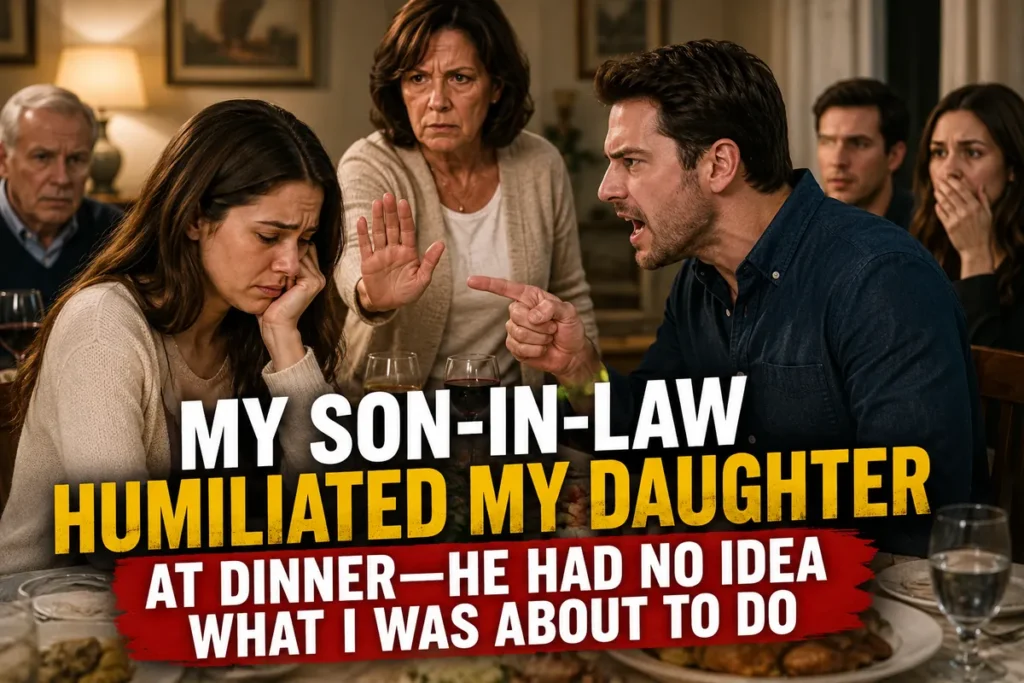
My son-in-law humiliated my daughter at our family dinner, and I could see the embarrassment on her face the moment he made that comment. I had spent years trying to respect their marriage and stay out of their private disagreements. But that evening, something changed. What he didn’t know was that I was no longer willing to sit quietly and watch my daughter be treated that way.
I Had Always Tried to Respect Their Marriage
Emily was thirty-two and had been married to Mark for nearly four years.
When they first met, I liked him.
He was polite, had a good job, and seemed genuinely interested in my daughter. He remembered birthdays and called on holidays. At family gatherings, he was usually the first person to offer help with the dishes.
I thought she’d found a good man.
Over time, though, I started noticing little things.
Mark would interrupt Emily while she was telling a story.
He’d correct details that didn’t really matter.
If she ordered something at a restaurant, he’d comment on her choice.
If she bought a dress, he’d ask how much it cost.
Sometimes, when she laughed loudly, he’d tell her she was making too much noise.
None of those moments seemed serious enough for me to step into their marriage.
At least, that’s what I told myself.
Emily was an adult. Her marriage was her business.
My role was to be there if she needed me, not to criticize every decision her husband made.
So I stayed quiet.
Looking back, I wonder if that silence lasted too long.
The Dinner Was Supposed to Be About Family
The dinner that night was for my husband and me. We were celebrating our wedding anniversary, and we’d invited our children and their spouses.
Emily arrived early with an apple pie she’d made herself.
She walked into the kitchen carrying it carefully.
“Mom, don’t let Dad see this yet.”
I laughed.
“Why?”
“Because he’ll eat half of it before we sit down.”
“That sounds like something he’d do.”
She smiled.
For a while, everything felt normal.
My son was telling a ridiculous story about something that had happened at work. My husband was pretending to be offended by it. Emily was laughing.
Then Mark arrived.
The mood shifted, though I couldn’t have explained why at the time.
The Comments Started During Dinner
We were halfway through the meal when Emily reached for the bread.
Mark looked at her.
“Are you sure you want that?”
She stopped.
“What?”
“The bread.”
Emily gave a nervous little laugh.
“I’m hungry.”
“I’m just asking.”
She put the bread back.
A few minutes later, she reached for the potatoes.
Mark glanced at her plate.
“Maybe don’t take so much.”
Emily froze again.
This time, she didn’t laugh.
My husband looked across the table at me.
He’d noticed too.
I wanted to say something, but I hesitated.
I kept thinking, Don’t turn a family dinner into a confrontation.
So I said nothing.
Then dessert arrived.
The Comment That Changed Everything
That was the moment I realized that my son-in-law humiliated my daughter in a way I could no longer dismiss as a harmless joke.
I brought Emily’s apple pie into the dining room.
“Emily made this,” I said.
She smiled.
Mark looked at the pie, then at her.
“You’re really going to have some?”
Emily looked down.
“Just a small piece.”
“You don’t need it.”
Her face changed.
She didn’t argue with him.
She simply placed her fork beside her plate.
That was when I realized I’d made a mistake by staying quiet.
I looked directly at Mark.
“Why are you talking to her like that?”
He seemed surprised.
“What?”
“You’ve commented on almost everything she’s eaten tonight.”
He shrugged.
“She’s my wife. I’m allowed to be concerned about her.”
“Concern doesn’t require embarrassing someone.”
He laughed.
“I was joking.”
I looked at Emily.
“Were you laughing?”
She shook her head.
“No.”
The room went quiet.
Emily Asked Me Not to Make a Scene
“Mom, please.”
I looked at her.
She wasn’t angry with me.
She looked frightened.
That stopped me.
I realized she wasn’t worried about the dinner anymore.
She was worried about what might happen after we all went home.
Mark leaned back in his chair.
“You’re making this into something it isn’t.”
I kept my voice calm.
“No. I’m telling you that you don’t get to humiliate someone in my home and call it a joke.”
He stared at me.
For once, he didn’t have an immediate answer.
The rest of dinner was uncomfortable.
Nobody brought up dessert again.
Emily Told Me What Had Really Been Happening
After everyone left, Emily helped me clear the dishes.
She waited until we were alone.
“Mom?”
“Yeah?”
“I’m sorry.”
“You don’t have to apologize.”
She stood at the kitchen counter for a moment.
Then she said, “He’s been doing this for a while.”
I stopped what I was doing.
“How long?”
She looked down.
“About a year.”
I couldn’t believe it.
“A year?”
She nodded.
“At first it was just little comments.”
She started listing them.
Her clothes.
Her food.
Her spending.
Her friends.
Even the way she talked.
“He says he’s trying to help me,” she said.
I dried my hands and turned toward her.
“Do you believe that?”
She hesitated.
“I used to.”
That answer hurt.
“I Don’t Recognize Myself Anymore”
Emily sat down at the kitchen table.
“He makes me feel like everything I do is wrong.”
I sat beside her.
“Why didn’t you tell me?”
“I thought you’d tell me I was overreacting.”
“I wouldn’t.”
She looked at me.
“He doesn’t yell all the time. That’s what makes it confusing.”
I understood what she meant.
There wasn’t one enormous incident she could point to.
It was a steady stream of little comments.
Enough to wear someone down.
Then she said something I’ll never forget.
“Sometimes I don’t recognize myself anymore.”
I reached across the table and took her hand.
“You don’t have to figure everything out tonight.”
She nodded.
“I know.”
I Didn’t Want to Make Her Decision for Her
That night changed the way I thought about my role as her mother.
I could have told Emily to leave Mark.
I could have confronted him again.
I could have called every relative in the family and told them what I’d witnessed.
But none of that would have solved the real problem.
Emily needed to make her own decisions.
What she needed from me was somewhere she could speak honestly without being judged.
So I listened.
Over the next few weeks, she told me more about what had been happening.
She’d stopped wearing certain clothes because she knew Mark wouldn’t like them.
She’d skipped dinners with friends because he complained whenever she went out.
She’d sometimes order less food than she wanted because she didn’t want another comment.
She had even apologized for things she hadn’t done simply because Mark was upset.
“I kept thinking that if I tried harder, he’d stop,” she told me.
I shook my head.
“You shouldn’t have to work harder to earn basic kindness from your husband.”
Sometimes, supporting an adult child through a difficult family situation means listening without immediately telling them what to do.
Healthy relationships require communication, listening, and constructive ways of handling disagreements. The American Psychological Association discusses these principles in its guidance on keeping relationships healthy.
Mark Called Me the Next Morning
The next morning, my phone rang.
It was Mark.
“Did you really think what you did last night was appropriate?”
I knew immediately what he meant.
“I think what you said to Emily was inappropriate.”
“You embarrassed me.”
“I asked you a question.”
“You interfered in my marriage.”
I took a breath.
“I’m not making decisions about your marriage.”
“Then stay out of it.”
“I will stay out of decisions that belong to you and Emily.”
I paused.
“But I won’t pretend I didn’t hear what you said at my dinner table.”
He was quiet.
Then he said:
“Emily doesn’t have a problem with it.”
I looked toward the kitchen.
My daughter was sitting at the table with a cup of coffee.
“She told me she does.”
There was silence on the other end.
Then he hung up.
I Set a Boundary in My Own Home
A few days later, Mark came over.
Emily was there, and so was my husband.
Mark wanted to talk.
“You can’t interfere with our marriage,” he said.
I nodded.
“That’s true.”
He seemed surprised by my answer.
“Emily is an adult,” I continued. “She gets to decide what happens in her marriage.”
Then I looked directly at him.
“But I get to decide what happens in my home.”
He said nothing.
“If you’re here, you will treat my daughter with basic courtesy. I’m not asking you to agree with her about everything. I’m asking you not to belittle her.”
His expression hardened.
“And if I don’t?”
“Then you won’t be welcome here.”
That was it.
No shouting.
No threats.
Just a clear boundary.
Mark Didn’t Expect Me to Follow Through
For years, I’d been polite.
I’d changed the subject when conversations became uncomfortable. I’d ignored comments that bothered me. I’d told myself that keeping the peace was more important than saying what I really thought.
Mark had mistaken that politeness for permission.
This time, I wasn’t backing down.
He stood up.
“Fine.”
Then he looked at Emily.
“Are you really okay with this?”
Emily took a breath.
“Yes.”
It was only one word.
But I could tell it took courage to say it.
Mark left.
Emily stayed.
Neither of us spoke for a few minutes.
Then she smiled.
It wasn’t a happy smile.
It was a relieved one.
Emily Started Finding Her Voice Again
Nothing changed overnight.
Emily didn’t suddenly decide what she wanted to do about her marriage.
Instead, she started making small changes.
She began seeing her friends again.
She wore clothes she liked without asking whether Mark approved.
She stopped apologizing whenever he was irritated.
And when he made a hurtful comment, she started telling him so.
Some conversations ended badly.
Some ended with both of them walking away frustrated.
But Emily was no longer pretending everything was fine.
She also started talking with a counselor.
That gave her somewhere private to sort through what she was feeling without having her decisions made for her.
I was glad.
Not because I wanted her marriage to end.
Not because I wanted it to continue.
I simply wanted her to understand what she wanted.
Then We Had Another Family Dinner
Three months later, Emily suggested another dinner at our house.
I was nervous.
So was she.
Mark came too.
At first, everything was awkward.
We talked about ordinary things.
Work.
The weather.
A movie my husband had watched.
Then Emily served dinner.
She sat down and began eating.
Mark looked at her plate.
My stomach tightened.
He started to say something.
“You’re having—”
He stopped.
He took a breath.
“Never mind.”
Emily looked at him.
Then she smiled.
“Thank you.”
That small exchange meant more to me than a dramatic apology would have.
He had caught himself.
And she had felt safe enough to acknowledge it.
The Apology Came Later
A few weeks after that dinner, Mark came to see me.
Alone.
“I owe you an apology,” he said.
I waited.
“I was cruel to Emily.”
I nodded.
“Yes.”
He looked uncomfortable.
“I kept telling myself I was helping her.”
“You weren’t.”
“I know.”
He sat down.
“I didn’t realize how much it was affecting her.”
I didn’t tell him everything was forgiven.
Instead, I said something simple.
“If you love her, listen when she tells you that something hurts.”
He nodded.
“I will.”
I hoped he meant it.
I Learned That Protecting a Daughter Doesn’t Mean Taking Over
For a long time, I thought being a good mother meant knowing when to stay out of my adult daughter’s life.
I still believe that matters.
But there’s a difference between respecting someone’s independence and ignoring what you can clearly see.
Emily didn’t need me to run her marriage.
She didn’t need me to make a decision for her.
She needed to know that what she was experiencing mattered.
She needed someone who would listen without immediately telling her what to do.
And she needed to know that her family would still be there, regardless of what happened next.
That was something I could give her.
Their Marriage Today
Emily and Mark are still married.
Their relationship isn’t perfect.
I don’t think any marriage is.
But something has changed.
Mark is more careful about the way he speaks to her.
Emily is more comfortable saying when something isn’t okay.
They’ve had difficult conversations about respect, communication, and expectations.
They’ve also had counseling together.
I don’t know what their marriage will look like five years from now.
Neither does Emily.
But she knows she doesn’t have to make herself smaller just to keep the peace.
And that’s what matters to me.
What That Dinner Taught Me
I still remember Emily’s apple pie sitting in the middle of the table that night.
She had spent the afternoon making it.
She was proud of it.
Then one careless comment made her feel ashamed for wanting a piece.
For years, I’d assumed that staying quiet was the mature thing to do.
That night taught me otherwise.
Not every disagreement requires a parent to step in.
But when someone you love is being repeatedly belittled, pretending not to notice doesn’t make the problem disappear.
I didn’t rescue Emily that night.
She wasn’t a child who needed rescuing.
I simply reminded her that she had a right to expect kindness from the person she’d married.
The rest was up to her.
Difficult situations can put enormous pressure on family relationships, especially when trust and communication begin to break down.
And perhaps that’s what being a mother to an adult daughter really means:
Knowing when to speak.
Knowing when to listen.
And knowing when to step back and let her choose her own path.
If my family’s dinner sounded familiar — the comments passed off as concern, your daughter shrinking a little more with each one — you are not powerless. But you’re not in charge of her marriage, either. Here are the words that helped in our home, and the approach that kept Emily talking to me instead of shutting me out.
Exact Words for Three Hard Moments
Short sentences work best. You are naming one behavior — not putting his whole character, or her whole marriage, on trial.
At the dinner table, while it’s happening:
“Mark, Emily is a grown woman — she can decide what goes on her own plate. Let’s just enjoy our dinner.”
At our table, it was a question that changed the air: “Emily, were you laughing?” She shook her head, and suddenly nobody in the room had to pretend it was a joke.
To him, privately and calmly — the next day, not in the heat of the moment:
“I’m not trying to make decisions about your marriage, and I won’t. But in my home, Emily gets spoken to with basic courtesy. That’s simply the rule here.”
To your daughter, when it’s just the two of you:
“You don’t have to decide anything tonight, and I’m not going to decide for you. I just need you to know that what I saw wasn’t okay — and that you can always tell me the truth.”
how to set boundaries with your mother-in-law — scripts that work
How to Talk to Your Daughter Without Pushing Her Away
This is the part nobody warns mothers about: your daughter loves him. Every conversation where you attack him, she hears an attack on her own judgment — and defending him starts to feel like defending herself.
Aim at the behavior, never the man. “That comment at dinner hurt” opens a door. “Your husband is cruel” slams one. Emily stayed silent for nearly a year partly because she was afraid of being told she’d overreacted — or chosen badly.
Ask more than you tell. “How did that feel?” is what started our real conversation in the kitchen that night. A lecture would have ended it.
Let her set the pace. Emily didn’t need a rescue plan. She needed weeks of small, honest talks — and a mother who would still be there if she stayed and if she left. Keep inviting them both into ordinary family life, too. Isolation is where comments like Mark’s grow. Your job is to be the safest person in her life, not the loudest voice in it.
When to Step Back
Stepping back doesn’t mean giving up on her. It means knowing the difference between supporting her and taking over.
Keep showing up, quietly, when:
- She still comes to you honestly and wants you to listen
- He is uncomfortable with your boundary but starting to catch himself — the way Mark stopped mid-comment at our next dinner
- She is making her own small changes and finding her own voice
Step back from stepping in — never from her — when:
- She starts hiding things or avoiding you after you raise it
- Every talk turns into her defending him instead of feeling supported by you
- She has asked for space and is sorting things out, for example with a counselor
- Your involvement is making her home life harder once you’ve gone home
One exception to everything above: if you ever believe she is in physical danger, that is not a family disagreement. Treat it as the emergency it is.
If you are on the other side of this kind of tension, these calm responses when your mother-in-law criticizes your parenting may help you keep the conversation steady.
Is It Disrespect — or Am I Overreacting?
After that dinner, I replayed every word in the car on the way home. Was I too sensitive? Did I embarrass Emily by noticing? If you are asking that question, you are not looking for a fight. You are looking for a clear head.
Do not judge one sharp comment by itself. Judge the pattern. A tired man can be short once and apologize later. Disrespect is what repeats, especially when other people are watching.
| What to check | More likely a bad moment | More likely a pattern |
|---|---|---|
| Frequency | Once, and not again | Almost every visit or call |
| Audience | The same in private | Worse in front of family |
| Target | Anyone, when stressed | Mostly Emily, or mostly you |
| Effect | Emily brushes it off | Emily goes quiet or shrinks |
Write down two or three specific moments, with dates if you remember them. If three of those lean toward pattern, trust what you saw. You do not need to win an argument about your feelings. You only need to decide what you will do next, calmly, and in a way that keeps Emily close to you.
That clarity matters more than replaying the last dinner perfectly.
Why Does He Do It?
I wanted a reason, because a reason felt like it would give me a fix. Sometimes there is one you can see. Sometimes there is not.
Insecurity is common. A man who feels judged in his wife’s childhood home may puff up, joke too hard, or put Emily down to feel bigger. Control is different. If he corrects her, mocks her, or cuts her off to keep the final say, the put-down is the point.
A values clash is also real. Some families tease, argue loudly, and hug five minutes later. If Mark grew up that way, he may not hear how it lands in your house — until someone tells him plainly, once.
Stress can spill over too: work, money, a new baby, no sleep. Stress explains a tone. It does not excuse humiliation, and it does not require you to accept it quietly.
I am not a therapist, and I will not label him. You do not need a diagnosis to set a boundary. Watch the behavior, not the motive you hope is behind it.
The Next Family Dinner: A Protocol That Protects Everyone
The goal is not just getting through dinner without a scene. It is simpler: Emily should not leave my table feeling smaller than when she arrived.
Before anyone sits down. Think about seating on purpose. Do not seat Emily between you and Mark like a referee who has to manage both sides. Seat her where she can catch your eye easily — across from you or beside you — so a look can say, I see you, you are not alone. Keep Mark where conversation is easy, not cornered like he is on trial.
Give the evening a soft ending. Plan for about two hours, not an open-ended night. Dessert, coffee, then a warm goodbye. Long, tired evenings are when tensions slip out. A shorter dinner that ends well beats a long one that ends in tears.
If it starts at the table. You do not need a speech. You need one steady sentence, said once, without heat.
Try: “Mark, let’s keep tonight kind. Emily worked hard to be here, and so did you.”
Or: “That landed hard. Let’s change the subject and enjoy the meal she came for.”
Or, looking at Emily, not at him: “Sweetheart, pass me the rolls when you’re ready. No rush at all.”
If it turns anyway. Do not match his volume. Use your exit line and mean it: “I love having you here, and I’m going to call it a night before we say things we’ll regret. Drive home safe.”
The next morning. Call or text Emily when Mark is not beside her, if you can. Keep it short: you loved seeing her, you noticed she went quiet, and your door is open. Do not re-run the whole dinner. One caring follow-up beats ten worried ones.
Protecting Your Place in Your Grandchildren’s Lives
This was my quiet fear, and maybe it is yours too: if I push back on Mark, will I lose Emily — and will I lose my grandchildren with her?
That fear can make a grandmother swallow things she should not swallow. I have done it. But pulling away from the whole family to avoid one man costs you the very people you are trying to stay close to.
Disengage from him without disappearing from them. You can be polite and brief with Mark and still be warm and fully present for Emily and the children. Keep invitations steady. If Sunday lunch was your rhythm, keep offering it. Predictability tells your grandchildren, without any speech, that Grandma’s house is a safe place where they belong.
Show up for the small things. School pickup when you are asked. A short Saturday visit. A birthday card on time. Grandchildren remember who was simply there, again and again, far more than one tense dinner.
Never make the grandkids messengers. Do not ask them what Daddy says about you, and do not send messages to Mark or Emily through them. Putting a child in the middle of adult tension frightens them and puts Emily in an impossible spot. If something needs saying, say it adult to adult, privately, or let it wait.
And keep your home the calm place. No interrogations after visits. No bad-mouthing their father in front of them, even when you are angry. They understand tone long before they understand words.
If you are also worrying about your own role as they grow, it helps to read honestly about a mother-in-law overstepping boundaries with grandchildren — protecting your place starts with respecting Emily’s place as their mother.
Rude, or Controlling? How to Tell the Difference
Not every rude comment is a danger sign. Families can repair rudeness. Control is heavier, because it follows a person home.
| Rude | Controlling or coercive |
|---|---|
| A sarcastic joke at dinner | Mocking Emily until she stops sharing opinions |
| Interrupting or talking over people | Deciding who she can see, and checking up on her |
| A short temper on a bad day | Anger used to scare her into agreeing |
| Criticizing the meal or the house | Criticizing her friends, clothes, work, or family to isolate her |
| Leaving early in a huff | Threatening to keep the children from you or from her |
| An apology that comes late | A pattern that never changes, only escalates |
I am not diagnosing Mark, and neither should you. Safety is your job, not labels.
If the right-hand column sounds familiar — especially fear, isolation, threats, or any physical danger — do not try to handle it with a family talk alone. Reach out to a trusted counselor, a domestic-safety organization, or local support services for guidance. If anyone is in immediate danger, call 911. Supporting Emily may mean helping her find professional help, not staging a confrontation that puts her at greater risk at home.
Signs of a Toxic Son-in-Law: What the Pattern Actually Looks Like
One rude dinner proves nothing. Every family has a story about a son-in-law who was short, strange, or sulking through one meal and perfectly decent the next. You already know how to test a single moment against a pattern — the table further up this page (“Is It Disrespect — or Am I Overreacting?”) does that work. What follows is the pattern itself, when it is fully formed. Read it in three directions, because a toxic son-in-law rarely misbehaves in only one.
Toward your daughter. The jokes are not jokes anymore — they are corrections wearing a smile, delivered where other people can hear them. He rolls his eyes or sighs when she speaks, the way you would at a child. Her opinions have quietly stopped appearing in family conversations; she tells small stories about her own life less and less, and checks his face before she answers a question nobody would have thought twice about a year ago. Decisions that used to be hers — money, friends, how a weekend gets spent — now route through him first, not always because he forbids anything out loud, but because she has learned the cost of not asking.
Toward her family. The warmth switches off when Emily — your daughter — leaves the room, and everyone left at the table can feel the temperature change. Your home, your cooking, your faith, your age, or your town has become material: small jokes at your expense that you are expected to laugh at, because objecting makes you the one with no sense of humor. Invitations are treated as impositions — attended late, left early, or resented openly — yet your absence from his family’s events would be noted and counted.
Toward her world. Her friendships have thinned since the wedding, one “we never see them anymore” at a time. Calls with you happen on speaker, or not at all. Visits need his approval, his schedule, or his presence, even when the visit is an ordinary Tuesday coffee. And the subtlest sign of all: she has started editing ordinary news before she tells you — not lying, exactly, just quietly removing anything that might need explaining when she gets home.
If you recognized one or two of these, once, in a hard season — a new baby, a lost job, no sleep — you are most likely looking at stress, and stress is handled with the patience this page has already described. But if you found the same items waiting for you at visit after visit, in more than one of the three groups, you are not looking at a rude man having bad days. You are looking at the pattern — and the scripts, the dinner protocol, and the boundaries above are the tools built for exactly that.
When He’s Disrespectful to You — Not Just to Her
Most of this page is about what he does to your daughter, because that is where a parent’s heart goes first. But there is a second version of this problem, and many parents are living in it quietly: he is a decent husband to her, and he is dismissive, mocking, or cold to you. He answers your questions with one word. He teases you about your hearing, your phone, your cooking, your opinions — always with the thin protection of “just joking.” You go home from family events feeling smaller, and then you feel guilty for minding, because your daughter is happy.
Here is the distinction that frees you: addressing how a man speaks to you is not intervening in his marriage. You are not ruling on their relationship. You are a person, in your own home and your own life, stating how you will be spoken to. That right does not expire when your child marries.
In the moment, say it once, briefly, and without making a performance of it: “I may be old-fashioned, but I don’t enjoy being spoken to that way. Let’s start that again.” Then let it go for the evening. A boundary said once, calmly, and then dropped carries more weight than the same point argued for ten minutes — and it gives him a clean chance to adjust, which a man who means no real harm will usually take.
If it continues, have the private version of the conversation — not at a family event, not through your daughter. Name specific moments, not his character: “At lunch on Sunday I asked about your work twice and got a joke about my questions both times. I don’t need us to be close. I do need basic courtesy, the same as I’d give you.” And know what you actually control: the terms of your own home and your own holidays, how many hours you spend being diminished at anyone’s table, and how warmly you keep showing up anyway for your daughter and your grandchildren. You cannot make him respectful. You can absolutely decide that your own dining room is a place where you are treated decently — by everyone who sits down in it.
One warning, because it is the mistake loving parents make most: never route this through your daughter. A complaint carried home by her becomes a problem inside her marriage, with your name on it. Say it to him yourself, plainly and once — or decide, honestly, to let a small thing go. Those are the two dignified options. The messenger route is neither.
When Disrespect Crosses the Line Into Abuse
Everything above this section assumes a difficult man and a strained family. This section is about the moment the problem changes category — because sometimes it does, and a parent who can see the line clearly is one of the most important safety nets an adult daughter can have.
Here is where the line sits. Disrespect is about manners and power at the table. Abuse is a pattern of control over a person’s life: over who she sees and how often, over money she earned, over whether she feels safe disagreeing in her own home. Look back at the “controlling or coercive” column of the table above — deciding who she can see, checking up on her, anger used to frighten her into agreeing. A bad-tempered man shows one of those on a terrible day and apologizes for it. An abusive pattern shows several of them, most of the time, and the apologies are part of the cycle rather than the end of it.
If that is what you are seeing, here is what a parent can actually do — and it is mostly not what instinct suggests:
Believe her the first time. If your daughter ever tells you something that frightens her, she has usually been deciding whether to say it for months. The first response she gets decides whether there is ever a second conversation. “I believe you, and I’m here” is the whole assignment in that moment.
Keep the line open, even when it goes quiet. Isolation is how control works — her world narrows until he is most of it. Keep calling. Keep inviting. Send the ordinary texts about nothing. An abuser’s strategy depends on her believing the door at your house has closed; your boring, steady persistence is the evidence that it hasn’t.
Do not confront him about it yourself. It feels like protection and it works like a warning: he learns she has been talking, and the consequences land on her after you have driven home. Your confrontation is the one move that can make her less safe.
Help her prepare only in ways she asks for. A spare key at your house. Important documents copied and kept with you. A bag of essentials in your spare room. Offered once, without pressure, and then left alone — these are things she can reach for on the day she decides she needs them, and that day has to be hers.
Bring in people whose whole job is this. The National Domestic Violence Hotline takes calls and chats from family members, not only from victims: call 1-800-799-SAFE (7233), text “START” to 88788, or chat at thehotline.org. Their advocates can help you think through what you are seeing and how to support her safely — and you do not need to be certain that what you are seeing “counts” as abuse before you call. Uncertainty is a perfectly good reason to call. And if you ever believe your daughter is in immediate danger, that is a 911 call, not a family discussion — the same exception this page has stated all along.
None of this makes you a rescuer, and that is the hard part to accept: she is an adult, and the leaving, if it comes, will be her decision made at her pace. Your job is narrower and, in the long run, more powerful — to be the person who believed her early, kept the door open, and was still standing there, unsurprised and unshaken, whenever she walked toward it.
Frequently Asked Questions
What should a mother do if her son-in-law humiliates her daughter?
A mother can offer support without taking control of her daughter’s decisions. Listening privately, expressing concern, and setting appropriate boundaries in her own home can provide meaningful support.
Should a parent interfere in an adult child’s marriage?
Parents generally cannot make decisions for an adult child. However, they can honestly express concerns, provide emotional support, and establish boundaries around behavior they will accept in their own home.
Is criticizing a spouse the same as helping them?
Not necessarily. Constructive feedback can be part of a healthy relationship, but repeated comments that embarrass or belittle a partner can damage trust and confidence.
Why might someone stay quiet when their spouse humiliates them?
People may stay quiet because they fear conflict, worry they are overreacting, or hope the behavior will eventually stop. Repeated criticism can also gradually affect someone’s confidence.
What was the mother’s most important decision?
Instead of making decisions about her daughter’s marriage, she chose to support her daughter and establish a clear boundary about how Mark could behave in her home.
Did Emily leave her husband?
No. In this story, Emily and Mark remained married and began working on their communication and relationship. Emily also began taking a more active role in setting her own boundaries.
Should I intervene in my daughter’s marriage?
Intervene in the moment, not in the marriage. If Mark humiliates Emily at your table, you can calmly stop that moment — your house, your standard of kindness. That is different from telling Emily to leave him. She has to live with any big decision, so she has to make it. Say what you saw, once and clearly. Offer help without conditions. Then respect that she is an adult, even when that is hard.
What if my daughter knows he’s disrespectful but doesn’t intervene?
She may know, and still freeze. At that dinner, Emily stared at her plate, and for a long time I read that as her taking his side. Now I think she was embarrassed and torn. Silence is not always agreement. Do not ask her to referee her own humiliation in public. Talk to her later, alone. Ask how she felt, not why she let it happen. If she brushes it off, do not argue. Plant the seed — I saw it, I love you, I’m here — and be there when she is ready.
What if he’s only disrespectful to me, not to her?
That still matters, and you are allowed to set a boundary about how you are treated in your own home. But handle it carefully. If you make it you-versus-him, Emily gets forced to choose — and the person asking her to choose usually loses ground. Keep it specific: the comment, the occasion, the change you need. Tell Emily what happened factually, without asking her to fix him. You can limit time with Mark without limiting time with her — a walk, a lunch, a call for just the two of you keeps your bond strong.
When should I limit contact?
Limit contact when visits repeatedly leave you — or Emily — shaken, when you have calmly named the behavior and nothing changes, or when being around Mark means pretending things are fine while your grandchildren watch adults accept cruelty. Limiting contact is not cutting Emily off. Say so plainly: “I need to step back from dinners for a while, and I still want you and the children in my life every week.” Offer another, safer way to stay close. If a real pattern of respect replaces the old one, you can widen that door again.
What are the signs that my son-in-law may not be a good husband?
Watch for a pattern, not an incident. The signs that matter are contempt that repeats — eye-rolling, jokes that shrink her, correcting her in front of others — control over her friendships, money, and time, and a daughter who is becoming quieter and smaller than the person you raised. One or two bad moments in a hard season usually mean stress. The same signs across several areas, visit after visit, are the answer — the full checklist is in “Signs of a Toxic Son-in-Law” above.
What if my daughter defends him and starts pulling away from me?
It is the most common turn in this story, and it is rarely really about you. Defending him feels, to her, like defending her own choice — every criticism of him lands as a judgment of her. Do not make her settle the question in an argument, because forced to choose in the moment, she will choose the home she lives in. Instead, stay warm, stay brief, and stop saying things she has to answer for later. Keep the invitations ordinary and the door visibly open. Daughters come back through doors that were never slammed — your steadiness now is what she will remember when she needs you.
How can I support my daughter if she’s struggling in her marriage?
Listen more than you advise — the conversation guide above (“How to Talk to Your Daughter Without Pushing Her Away”) exists because lecturing is the fastest way to end the conversation for good. Say the two sentences that make you her safest person: “I believe you” and “My door is open, whatever you decide.” Offer practical help that is hers to accept or refuse — a spare key, a ride, help finding a counselor, a place to land for a few days. And if what she describes includes control or fear, remember that the National Domestic Violence Hotline (1-800-799-SAFE) advises family members too. Support means she never has to wonder where you stand — even when she isn’t ready to act on it yet.