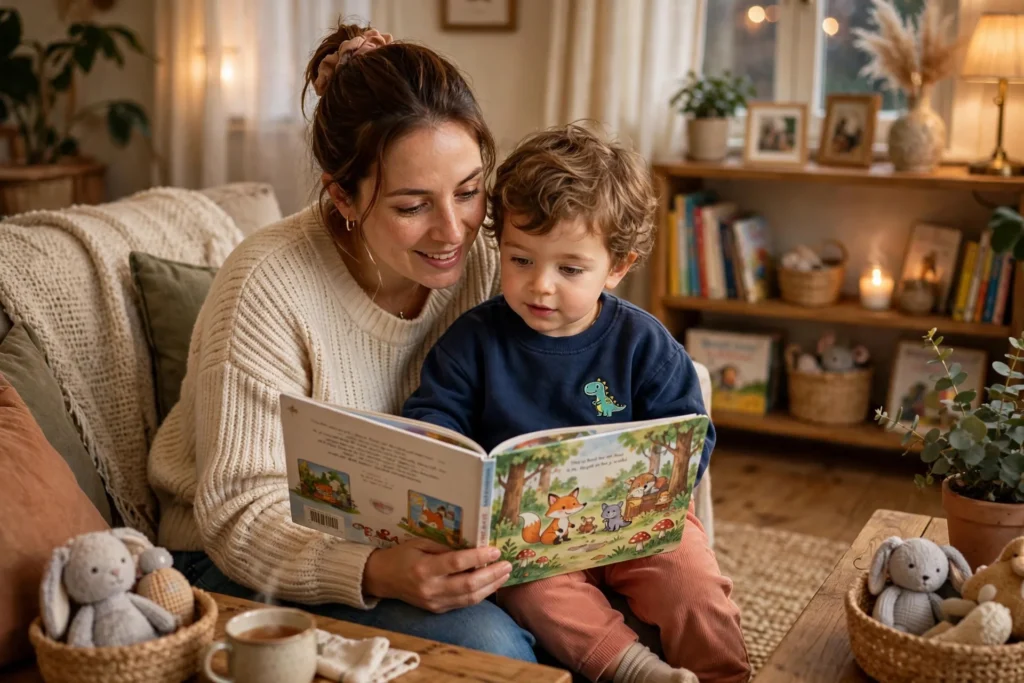
Between school drop-offs, soccer practice, work deadlines, and the laundry pile that never seems to shrink, today’s American parents are stretched thinner than ever. If you’ve ever searched for positive parenting tips at 11 p.m. while rocking a fussy toddler back to sleep, you’re not alone — and the fact that you’re looking for better tools already says a lot about the kind of parent you are.
The good news? You don’t need a perfect schedule or hours of free time to parent with warmth and intention. These gentle parenting tips are built for real, busy households: practical, research-backed, and doable in the small pockets of time you actually have. Whether you need parenting advice for toddlers who won’t share their toys or school-age kids testing every boundary, these ten strategies will help you stay calm, connected, and consistent — even on the craziest weeks.
1. Connect Before You Correct
When your child misbehaves, your instinct might be to jump straight to consequences. But kids — especially young ones — can’t hear a lesson when they’re flooded with big emotions. Get down to their eye level, acknowledge what they’re feeling, and only then address the behavior. One father’s story of learning to listen before lecturing shows how powerful this shift can be.
Try this: “I can see you’re really frustrated that your tower fell down. It’s okay to feel mad. It’s not okay to throw the blocks. Let’s rebuild it together.” This is the foundation of all positive parenting tips: connection first makes correction actually stick, because your child feels understood instead of attacked.
2. Positive Parenting Tips for the Morning Rush: Build Routines, Not Reminders
Mornings in most American homes are chaos: backpacks, permission slips, missing shoes, and a school bus that waits for no one. Instead of repeating “hurry up!” fifteen times, build a visual routine chart with your kids.
Draw or print simple pictures for each step — get dressed, brush teeth, eat breakfast, grab backpack — and let your child check them off. Kids thrive on predictable structure, and a chart turns you from the nagging manager into their teammate. Bonus: fewer power struggles before 8 a.m. means everyone starts the day calmer.
3. Name the Feeling to Tame the Feeling
Child psychologists call it “affect labeling,” but you can just think of it as giving emotions a name. When your toddler is melting down in the Target checkout line because you said no to the candy, narrate what you see: “You’re disappointed. You really wanted that candy, and it’s hard to hear no.”
You don’t have to fix the feeling or give in. Simply naming it helps your child’s brain shift from pure reaction into processing mode. Over time, they’ll start naming their own feelings — one of the most valuable life skills you can teach.
4. Offer Two Choices You Can Live With
Toddlers and preschoolers crave autonomy, which is why “put your shoes on” so often turns into a standoff. Sidestep the battle by offering two acceptable options: “Do you want to wear the red sneakers or the blue ones?” “Should we read one book or two before bed?”
Both choices get you where you need to go, but your child feels a sense of control. This one piece of parenting advice for toddlers can eliminate half of your daily power struggles overnight.
5. Gentle Parenting Tips for Discipline: Choose Natural Consequences
Gentle parenting doesn’t mean no boundaries — it means consequences that teach instead of punish. When your child refuses to wear a jacket, the natural consequence is feeling cold (bring the jacket along; they’ll ask for it). When they dawdle and miss the playground window, the natural consequence is less playtime.
Natural consequences connect directly to the choice your child made, which makes the lesson far more powerful than an unrelated punishment like losing screen time for not eating vegetables. Health experts agree with this approach: the American Academy of Pediatrics advises against yelling, shaming, or spanking — see these positive discipline strategies by age for what to do instead.
6. Try the 10-Minute “Special Time” Rule
Here’s a secret from family therapists: ten minutes of fully present, child-led play does more for your relationship than an entire distracted Saturday. Set a timer, put your phone in another room, and let your child choose the activity. Follow their lead completely — no teaching, no correcting, no multitasking.
Call it “special time” and protect it like any other appointment. Kids who feel regularly seen and enjoyed by their parents act out less, because their connection cup is already full.
7. Model the Behavior You Want to See
Children are relentless copycats. If you want them to speak kindly, manage frustration, and apologize sincerely, they need to watch you do it first. When you lose your temper — and every parent does — narrate the repair out loud: “Mommy yelled, and that wasn’t okay. I’m feeling stressed about work, but that’s not your fault. I’m sorry.”
This isn’t weakness; it’s the single most powerful teaching tool you own. Of all the gentle parenting tips here, this one teaches the most without a single lecture. Kids learn emotional regulation by watching the adults around them practice it imperfectly and honestly.
8. Get Down on Their Level — Literally
Towering over a three-year-old while giving instructions is intimidating, even when your tone is gentle. Crouch or kneel so you’re eye to eye before you speak. Touch their shoulder. Wait until you have their attention.
This small physical shift changes the entire dynamic from confrontation to conversation. It’s one of the simplest gentle parenting tips out there, and parents are always surprised by how dramatically it reduces defiance.
9. Repair After You Rupture
No parent gets it right every time. You’ll snap during the witching hour, threaten a consequence you don’t mean, or check your phone when your kid is telling you about their day. What matters isn’t perfection — it’s repair.
Go back, own it simply, and reconnect: “I was grumpy earlier and I spoke harshly. You didn’t deserve that. Can we have a do-over hug?” Repair teaches your child that relationships can survive mistakes, which is a lesson they’ll carry into every friendship and future partnership. See how one family navigated a parenting crisis and found their way back.
10. Take Care of the Caregiver
You cannot pour from an empty cup, and positive parenting is nearly impossible when you’re running on four hours of sleep and cold coffee. Think of this as one of the most overlooked positive parenting tips: a regulated parent raises a regulated child. Self-care for parents isn’t selfish — it’s strategic. Trade off bedtime duty with your partner once a week. Say yes when a grandparent offers to babysit. Take the walk around the block alone.
Even small resets — five deep breaths in the pantry, a favorite song in the car before pickup — protect your patience. Your kids don’t need a perfect parent; they need a regulated one.
Screen Time Without a Daily Battle
Of all the fights in a busy family’s day, the screen fight is the most predictable — and the most winnable, because it is almost never really about the screen. It is about the transition: stopping something absorbing to do something boring. Children who explode when the tablet goes off are not addicted to the tablet. They are furious at the abruptness. Fix the transition and the battle shrinks.
Agree the limit before the screen goes on, not when it must go off. “You can watch until the timer rings” works; “Okay, that’s enough now” after forty unmeasured minutes does not. Set the timer together, where the child can see it, and let the timer be the bad guy. When it rings, the rule — not you — ends the show. Children argue with parents far more readily than they argue with a beeping kitchen timer.
Give a two-warning landing, every time. Five minutes before the end, say so: “Five more minutes, then we switch off.” Two minutes before, say it again: “Two more minutes — what happens next is bath time.” The warnings are not negotiations; they are a runway. A child who hears the landing coming twice rarely crashes on arrival. And when the show ends, offer the next thing immediately, not a void: “Tablet off, shoes on, we’re going to the park” beats “Tablet off” followed by silence, because an empty afternoon is an invitation to beg for the tablet back.
Protect three screen-free zones and mean it. Meals, the hour before bed, and car rides short enough to talk through — pick zones that fit your family and hold them without exception, including for the adults. A screen-free dinner where the parents are scrolling is not a rule, it is a lecture, and children spot the difference instantly. The zones work because they are predictable: the child stops asking at dinner after the tenth dinner in a row where the answer is the same, and the energy you used to spend on that argument becomes free for everything else.
When Grandparents or Caregivers Do It Differently
Positive parenting is hard enough when one household follows it. Many busy families also rely on grandparents, babysitters, or after-school caregivers — and those adults often parent from a different era or a different playbook. The candy before dinner, the threat instead of the choice, the “because I said so” where you would offer two options: none of this makes them bad caregivers. It makes them inconsistent ones, and inconsistency is what children test first.
Agree two or three non-negotiables, and let the rest go. You will not convert a grandmother’s whole parenting style in one conversation, and trying will cost you the childcare you depend on. Pick the two or three things that matter most — no yelling as discipline, no food as reward or punishment, the bedtime routine stays as written — and ask for those specifically, warmly, and in writing if it helps. Everything else, let go for now. A grandparent who follows three rules reliably is worth more than a grandparent who resents ten.
Explain the why once, then hand them the script. “We don’t use threats because they work today and cost us trust tomorrow” lands better than “Don’t do that.” Then give them the replacement words, not just the prohibition: instead of “If you don’t stop, no TV,” try “Do you want to build the tower or read the book?” Caregivers repeat what is easy to say in the moment. If the only easy sentence they have is the old one, the old one is what your child will hear.
Thank them for what they do right, out loud, in front of the kids. “Grandma did such a great job with the bedtime story tonight” does more for consistency than a week of corrections. People repeat what gets appreciated. And when a rule does get broken — it will — correct it privately, kindly, and once: “I know it’s easier to give in at the shop, and I get it — but the candy rule matters to us because the crash afterwards ruins her evening.” No lecture, no audience, no scorekeeping. The relationship with the caregiver is part of your child’s safety net; protect it the way you protect every other part of this system — with warmth, clarity, and repair when it frays.
Frequently Asked Questions
What exactly is positive parenting?
These positive parenting tips are built on an approach focused on building a strong parent-child connection, teaching through guidance rather than punishment, and using empathy and clear boundaries together. It’s backed by decades of child development research showing that warm, responsive parenting produces more confident, cooperative kids.
Does gentle parenting mean letting kids do whatever they want?
Not at all. These gentle parenting tips still include firm boundaries and consistent expectations — they’re just enforced without shame, yelling, or harsh punishment. Think “kind and firm at the same time”: the rules are clear, and they’re delivered with respect. Mayo Clinic’s pediatricians discuss healthy, positive ways to discipline that keep boundaries firm without harshness.
When should I start using these techniques?
Right now, whatever your child’s age. These positive parenting tips work from toddlerhood through the teen years, though you’ll adjust the language and expectations. It’s never too late to shift your approach — kids respond to change faster than most parents expect.
How do I stay calm during a public toddler meltdown?
First, remind yourself the meltdown is normal brain development, not bad behavior or a reflection on you. Get low, keep your voice soft and slow, and focus on your child’s feelings rather than the staring strangers. Have a simple exit plan (step outside, sit in the car) so you never feel trapped.
Can positive parenting work for strong-willed kids?
Absolutely — strong-willed kids often thrive with this approach because it respects their need for autonomy. Lean heavily on choices, routines, and collaborative problem-solving (“What’s your idea for fixing this?”). They may test boundaries longer, but the connection you build pays off enormously.
How do I handle screen time without constant arguments?
Agree the limit before the screen goes on and let a visible timer end it, give five-minute and two-minute warnings before switch-off, and protect a few screen-free zones — meals, the hour before bed, short car rides — for adults too. See “Screen Time Without a Daily Battle” above.
What if grandparents undermine our parenting rules?
Pick two or three non-negotiables and ask for those specifically, explain the why once, and hand caregivers the replacement words to use instead. Thank them publicly for what they do right and correct slips privately, kindly, and once. See “When Grandparents or Caregivers Do It Differently” above.
Keep reading
Final Thoughts: Start Small With Positive Parenting
Positive parenting isn’t about being a perfect parent — it’s about being a present, intentional one. You won’t nail all ten of these gentle parenting tips every day, and that’s completely fine. Pick one or two that fit your family’s current chaos level and start there. Small, consistent shifts in how you connect, correct, and repair will compound into a calmer home and a deeper relationship with your kids.
Remember: the fact that you’re reading parenting advice for toddlers, tweens, or teens at all means you’re already doing the most important thing — showing up and trying. Your kids don’t need perfection. They need you.
What’s your biggest parenting challenge right now? Share it in the comments — we’d love to hear from you, and your story might help another family too. If these tips helped, please share this article with a fellow parent who could use them.